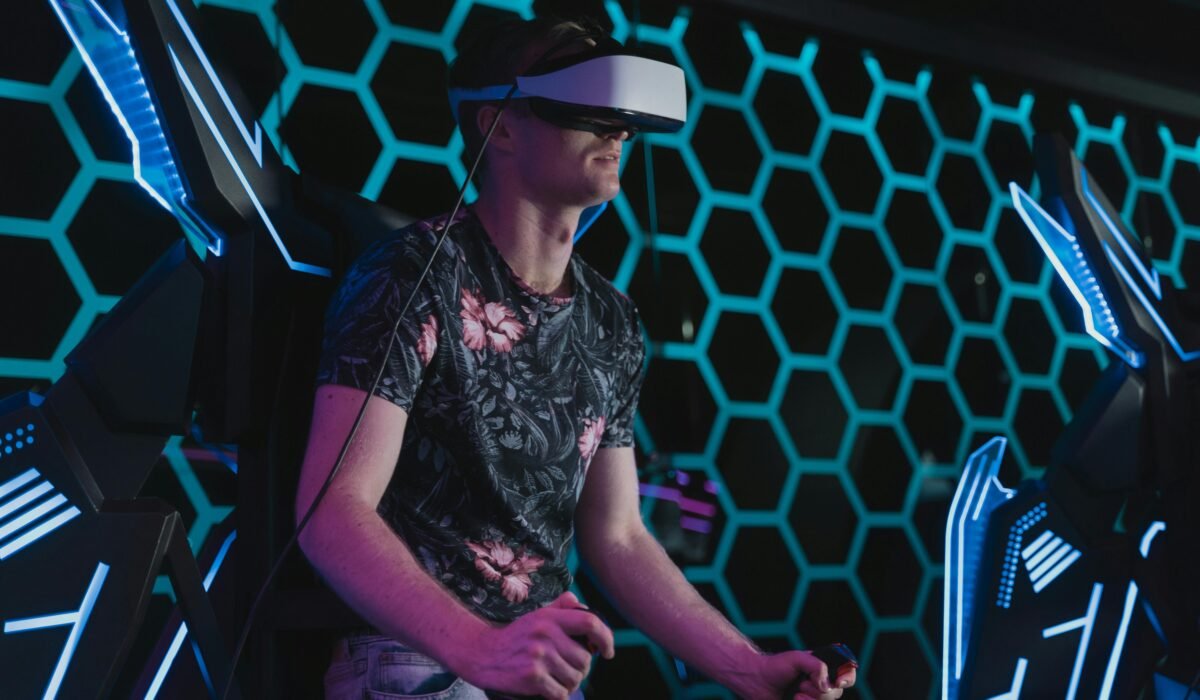
Are you wondering how advanced technology is reshaping the virtual worlds we love? The role of AI in gaming explained reveals a revolution in how interactive entertainment experiences are crafted and enjoyed. This article will dive deep into the fascinating ways artificial intelligence is transforming everything from game development to the very fabric of player engagement, promising to unveil the future of your favorite digital adventures.
What is Artificial Intelligence in Gaming?
At its core, artificial intelligence in gaming refers to the technologies and algorithms that enable non-player characters (NPCs) and game systems to exhibit intelligent behaviors, adapt to players, and generate dynamic content. Think of it as the brain behind the game world, allowing it to feel more alive and responsive. Unlike traditional scripting, modern AI aims for unpredictability and emergent gameplay.
This isn’t just about making enemies smarter; it’s about creating complex systems that can learn, evolve, and surprise you. The goal is to move beyond pre-programmed responses to genuinely adaptive and engaging interactions. What most people miss is that AI covers a broad spectrum, from simple pathfinding to sophisticated machine learning video games that personalize your entire journey.
How is AI Used in Game Development Today?
Today, AI is deeply embedded in nearly every stage of game development, from initial concept to post-launch support. It’s not just a feature within games but a powerful suite of AI tools for game design that streamlines workflows and unlocks new creative possibilities. A 2025 Google Cloud survey found that 90% of game developers are already integrating generative AI into their workflows, with 95% reporting it reduces repetitive tasks.
Streamlining Production with Generative AI
One of the most impactful applications is generative AI game development, which automates the creation of assets, environments, and even code. Tools like ChatGPT and Midjourney are commonly used for concept art, story generation, and code assistance, while Meshy can create 3D models and textures from simple text prompts. This significantly accelerates production timelines; for example, AI reduced game development cycles by an average of 25% for studios in 2023, cutting 18-month projects to 13.5 months, according to a McKinsey Gaming Report.
Enhancing Quality Assurance and Testing
AI also plays a crucial role in quality assurance (QA) and game testing. AI-powered systems can autonomously play through games, identify bugs, and stress-test game mechanics far more efficiently than human testers. This automation cut QA costs by 40%, equating to $800 million in industry-wide savings in 2023, as reported by Capgemini Gaming Services. It’s about finding issues faster, allowing developers to focus on refining the player experience.
Examples of AI in Games: Revolutionizing Interactive Experiences
The impact of AI in gaming explained through real-world examples highlights how it’s fundamentally changing how we interact with virtual worlds. From expansive universes to cunning adversaries, AI is the silent force behind many memorable moments.
Dynamic NPCs and Adaptive Gameplay
Classic examples like *F.E.A.R.* showcase enduring excellence in AI, where enemies coordinate attacks, flank players, and communicate responsively. More recently, *Middle-Earth: Shadow of Mordor*’s Nemesis System introduced AI-powered NPC behavior where enemies remember past encounters, adapt their tactics, and even get promoted, creating personalized rivalries. The *XCOM Series* also uses improved AI to make non-player characters smarter and more unpredictable in battles.
Procedural Content Generation and World Building
Many modern games leverage AI for procedural content generation, building vast and unique worlds on the fly. *No Man’s Sky* is a prime example, using AI to create billions of distinct planets, ecosystems, and lifeforms for players to explore. Ubisoft’s Ghostwriter, another innovative AI tool, generates vast amounts of background dialogue for open-world games, like those found in *Cyberpunk 2077* or *The Witcher 3: Wild Hunt*, enhancing immersion without manual writing for every line. The browser game *Infinite Craft* (2024) even uses generative AI to create new elements based on player combinations.
How Does AI Enhance the Player Experience?
AI’s true power lies in its ability to make games more engaging, immersive, and tailored to individual players. It’s all about creating a richer player experience AI can uniquely deliver.
Personalized and Immersive Worlds
AI enables games to adapt to your playstyle, offering dynamic difficulty adjustment or crafting unique narratives based on your choices. Imagine games where characters remember your past interactions, influencing their dialogue and quests; Inworld AI provides systems that allow game characters to hold natural conversations and remember past interactions, making game worlds feel genuinely alive. This level of personalization makes each playthrough feel distinct and deeply personal.
Realistic Graphics and Performance
Beyond character behavior, AI enhances visual fidelity and performance. NVIDIA’s DLSS (Deep Learning Super Sampling), for instance, uses AI to upscale images, boost frame rates, and reduce latency without sacrificing visual quality. This means smoother gameplay and more stunning graphics, allowing you to fully appreciate the artistry of modern titles.
The Benefits and Challenges of AI in Gaming
The rapid integration of AI brings significant advantages, but it also introduces complex AI game development challenges that studios must navigate. Understanding both sides is crucial for appreciating the current landscape of AI in gaming.
Key Benefits
The benefits are clear: increased efficiency, richer game worlds, and more engaging gameplay. As Rick Arpin, KPMG U.S. Gaming Lead, noted, while there’s a “clear gap between ambition and execution” in AI adoption, the potential is undeniable.
- Accelerated Development: Generative AI in game development dramatically speeds up asset creation, level design, and even coding, allowing studios to deliver games faster and iterate more quickly.
- Enhanced Immersion: From advanced AI NPC behavior to dynamic storytelling, AI creates more believable and responsive game worlds, deepening player engagement. Games featuring advanced AI NPC systems had 31% lower 30-day churn rates in 2025 (Dataintelo, 2026).
- Personalized Experiences: AI can tailor game content, difficulty, and narrative paths to individual players, making each experience unique and highly replayable.
- Cost Reduction: Automation in areas like QA and content generation leads to significant savings, freeing up resources for creative innovation.
Significant Challenges
Despite the promise, implementing AI isn’t without its hurdles. These often go beyond just cost, touching on technical and ethical complexities.
- Computational Efficiency: Training and running complex AI models require substantial processing power, which can be a bottleneck, especially for multi-platform games.
- Interpretability and Predictability: “Black box” AI models can be difficult to understand and debug, leading to unpredictable or “artificial stupidity” moments in NPCs.
- Data Requirements: Machine learning video games need vast amounts of high-quality data for training, which can be expensive and time-consuming to acquire.
- Balancing AI with Performance: Integrating powerful AI without compromising game performance and stability is a constant tightrope walk for developers.
Ethical Implications and Player Sentiment: Navigating AI in Gaming
The rise of AI in gaming isn’t just a technical discussion; it’s also a cultural one, raising significant ethical implications and often stirring strong player sentiment. Navigating these waters responsibly is key to the technology’s long-term success.
Addressing Ethical Concerns
The ethical landscape for ethical AI gaming is complex. Concerns range from artistic integrity, where some fear AI-generated content might dilute human creativity, to potential biases in AI models. There are also important questions around player data privacy, the energy consumption of AI systems, and the “human element” in creative processes. Julian Togelius, a Professor of Computer Science at NYU, noted the gaming community has a “very, very fraught relationship with AI, and it’s not getting better,” even calling it a “disaster.” This highlights the need for transparency and responsible development. For more on broader AI ethics, you might find our article on AI in Self-Driving Cars: Beyond Tech to Trust & Ethics relevant.
Understanding Player Sentiment
Player sentiment towards AI is mixed. While many appreciate the enhanced immersion and dynamic experiences, there’s also apprehension. Concerns about AI “taking jobs” from human developers or creating soulless, generic content are prevalent. Keisha Howard, Founder of Sugar Games, observed that “The rapid pace of change… has left many bewildered, questioning their relevance and direction.” Developers must listen to this feedback, ensuring AI serves to augment, not diminish, the unique magic of human-crafted games. Xbox CEO Asha Sharma’s decision to wind down Copilot on mobile and stop development on console, citing a realignment with user experience, demonstrates how major industry players are strategically adjusting to public and internal feedback regarding AI implementation.
The Future of AI in Gaming: What’s Next for Developers and Players?
The future of gaming AI promises even more transformative changes, pushing the boundaries of what interactive entertainment can be. The market for AI in games, valued at $3.28 billion in 2024, is projected to reach over $51 billion by 2033, growing at an astounding CAGR of 36.1% (Grand View Research, 2024). This growth signals massive innovation ahead.
Hyper-Personalization and Dynamic Worlds
Expect games to become even more reactive and personalized. Julian Togelius envisions “a big open-world game where you drive for hours in a random direction, and it creates new cities with new quests and architecture styles.” This vision points to a future where every playthrough is truly unique, with AI continually generating fresh content and adapting narratives to player choices. Imagine an AI Smart Home Personalization system applied to your gaming world, constantly optimizing for your enjoyment.
AI as a Creative Partner
The role of human creativity won’t be replaced but amplified. Developers will increasingly collaborate with AI, using it as a powerful tool to bring ambitious visions to life faster and more efficiently. We’ll see new roles emerge, such as “AI prompt engineers” or “AI game designer’s muses,” focusing on guiding AI tools to achieve specific creative outcomes. By 2026, nearly 67% of the top 100 global game studios will have embedded at least one AI-driven development tool into their production pipeline, a significant leap from 29% in 2021 (Dataintelo, 2026). This trend underscores AI’s growing role as an indispensable creative partner.
Frequently Asked Questions
How is AI used in game development?
AI is used extensively in game development to automate content creation, enhance NPC behavior, streamline testing, and personalize player experiences. Developers leverage generative AI for assets and stories, machine learning for adaptive gameplay, and AI tools for efficient quality assurance, significantly reducing development cycles and costs.
What are some examples of AI in games?
Notable examples of AI in games include *Middle-Earth: Shadow of Mordor*’s Nemesis System for adaptive enemies, *No Man’s Sky*’s procedural generation for vast worlds, and Ubisoft’s Ghostwriter for background dialogue. AI also powers realistic player movements in games like *FIFA 22* and graphics enhancements through technologies like NVIDIA’s DLSS.
What is the future of AI in gaming?
The future of AI in gaming involves hyper-personalization, dynamic content generation, and AI becoming an even more integral creative partner for developers. Expect increasingly intelligent NPCs, game worlds that adapt in real-time to player actions, and AI tools further accelerating development, leading to richer and more diverse interactive experiences.
How does AI enhance player experience in games?
AI enhances player experience by creating more immersive and responsive game worlds, offering personalized challenges, and providing dynamic narratives. Through advanced NPC behaviors, adaptive difficulty, and procedural content generation, AI ensures that games feel more alive, unpredictable, and uniquely tailored to each player’s journey.
The journey of AI in gaming is just beginning, promising a future where interactive entertainment is more dynamic, personalized, and creatively unbounded than ever before. As developers continue to harness its power responsibly, players can look forward to truly revolutionary experiences. Dive into your favorite game today and see if you can spot the subtle, yet powerful, hand of AI at play!