Key Takeaways
- Over 60% of auto repair shops are expected to use AI technology by late 2026, according to WickedFile (2026).
- The global AI in automotive market was valued at USD 12.84 billion in 2025, according to Fortune Business Insights (2026).
- AI significantly streamlines fault identification, reducing thousands of codes to 5-10 actionable issues per vehicle, as noted by Brian Silva of Uptake (2026).
- Predictive maintenance, enabled by AI, shifts vehicle care from reactive repairs to proactive, scheduled servicing.
- Tools like OBDAI and MECH AI empower mechanics with advanced diagnostic capabilities and step-by-step repair guidance.
Are you wondering how modern technology is reshaping the way your car gets fixed? The integration of **AI in vehicle diagnostics** is fundamentally transforming how automotive issues are identified, analyzed, and repaired, promising a future of smarter, faster, and more accurate service. This article will explore seven powerful ways artificial intelligence is enhancing vehicle diagnostics and repair, empowering mechanics and improving vehicle reliability for everyone.
Quick Answer: AI enhances vehicle diagnostics and repair by enabling predictive maintenance, accelerating fault identification, and providing smarter repair guidance. It analyzes vast data to detect issues early, optimize service schedules, and empower mechanics with precise troubleshooting.
How is AI Transforming Vehicle Diagnostics and Repair?
AI is transforming vehicle diagnostics and repair by equipping mechanics with advanced tools that analyze complex data, predict potential failures, and offer precise troubleshooting guidance. This shift moves the industry from reactive repairs to proactive maintenance, significantly improving efficiency and accuracy. The adoption rate of AI in automotive R&D is projected to reach 75% by 2025, according to Careertrainer.ai (2026).
What does this mean for your vehicle? Essentially, AI systems can process information from a car’s sensors, historical repair records, and even external data like weather patterns to identify subtle anomalies that human technicians might miss. This deep analysis capability is a game-changer for **AI in vehicle diagnostics**, ensuring that problems are caught earlier.
AI acts as a powerful assistant, augmenting the mechanic’s expertise rather than replacing it. It helps decipher the myriad of diagnostic trouble codes (DTCs) and provides a clearer path to the root cause of an issue.
For instance, Bosch demonstrated its “Super Technician” at AAPEX in November 2025, an AI-powered diagnostic assistant that leverages Bosch’s extensive global knowledge base. This tool helps technicians diagnose problems faster by drawing on countless past repair scenarios and solutions.
Key Benefits of AI in Automotive Maintenance
AI in automotive maintenance offers a multitude of benefits, including increased accuracy, faster repair times, enhanced safety, and significant cost savings for both repair shops and vehicle owners. These advantages are driving a rapid expansion of **AI in vehicle diagnostics** across the industry.
One of the most immediate benefits is the ability to identify issues with unprecedented precision. AI algorithms can detect patterns in vehicle data that indicate impending failure, often long before any warning lights appear. This early detection capability is crucial for preventing costly breakdowns.
The global AI in automotive market was valued at USD 12.84 billion in 2025 and is projected to grow to USD 51.68 billion by 2034, exhibiting a CAGR of 16.7% during the forecast period, according to Fortune Business Insights (2026).
Here are some key benefits that highlight the impact of **AI in vehicle diagnostics**:
- Accelerated Fault Identification: AI rapidly analyzes vast datasets from vehicle sensors and historical records to pinpoint root causes, drastically cutting down diagnostic time.
- Enhanced Accuracy: By cross-referencing data points and applying machine learning models, AI reduces the chances of misdiagnosis, leading to more effective repairs.
- Predictive Capabilities: AI enables systems to forecast potential component failures, allowing for proactive maintenance before issues escalate into major problems.
- Optimized Repair Guidance: AI tools can provide step-by-step repair instructions, wiring diagrams, and parts recommendations specific to the vehicle and fault, streamlining the repair process.
- Reduced Downtime: Faster and more accurate diagnostics mean vehicles spend less time in the shop, improving customer satisfaction and shop throughput.
- Cost Efficiency: Early detection and precise repairs prevent secondary damages and reduce the need for repeat visits, saving money on parts and labor.
Predictive Maintenance: The Power of AI in Vehicle Diagnostics
Predictive maintenance is arguably the most significant application of **AI in vehicle diagnostics**, allowing for the anticipation of potential failures and the scheduling of maintenance *before* a breakdown occurs. This proactive approach optimizes vehicle uptime and extends component life. Brian Silva, Senior Director of Data Science at Uptake, noted that by applying AI, his company can “reduce those 8,000 codes to just 5–10 actionable issues per vehicle each year,” significantly streamlining fault identification for fleets (2026).
How does this work in practice? AI systems continuously monitor vehicle health data, including engine performance, brake wear, battery status, and fluid levels. They learn normal operating parameters and flag deviations that suggest an emerging problem. This is a huge leap from traditional reactive maintenance, where repairs only happen after a failure.
This capability is particularly beneficial for commercial fleets, where unexpected downtime can lead to substantial financial losses. By predicting issues, businesses can schedule maintenance during off-peak hours, minimizing disruption.
For example, an AI system might detect a subtle increase in vibration from a specific wheel bearing over several weeks, even if it’s still within acceptable limits. The AI, having analyzed thousands of similar vibration patterns, could predict that this bearing is likely to fail within the next few months. This allows the mechanic to replace the part during a scheduled service, preventing a roadside breakdown. This is the true power of **AI in vehicle diagnostics** for proactive care.
Top AI-Powered Tools for Auto Mechanics
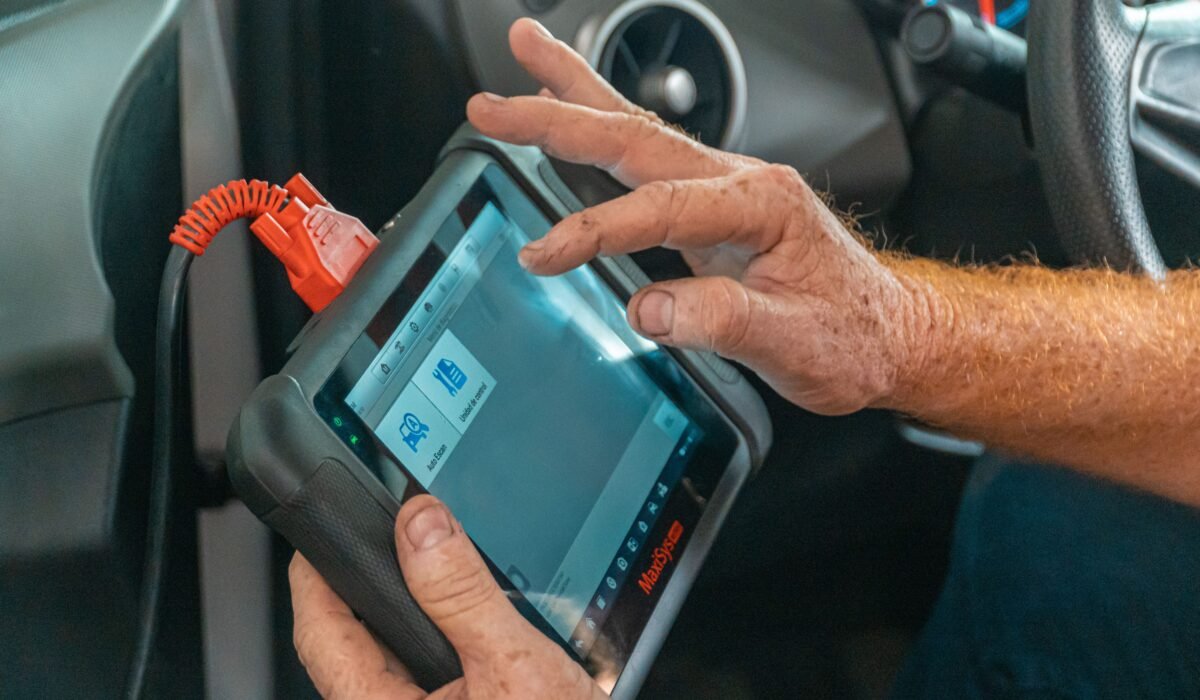
Numerous AI-powered tools are emerging to assist auto mechanics, providing them with advanced diagnostic capabilities, repair guidance, and predictive insights. These innovations are making **AI in vehicle diagnostics** more accessible and practical for everyday use.
These tools range from sophisticated diagnostic software used in professional repair shops to user-friendly apps for DIY enthusiasts. They leverage AI to interpret complex data, offer repair estimates, and guide users through troubleshooting steps. Over 60% of auto repair shops are expected to use some form of AI technology by late 2026, according to WickedFile (2026).
One notable example is OBDAI, billed as the world’s first AI OBD2 scanner app. Its AI assistant, ARIA, autonomously selects sensors, analyzes live data, and diagnoses root causes through an OBD-II port, making advanced **AI in vehicle diagnostics** available to a broader audience.
Here’s a look at some leading AI-powered tools that are transforming automotive repair:
- OBDAI: This app uses an AI assistant (ARIA) to analyze live OBD2 data and diagnose root causes, providing a smart, guided approach to vehicle issues.
- Carly: A popular OBD2 scanner app that pairs a physical Bluetooth scanner with a mobile app. It reads codes, performs diagnostics, detects odometer fraud, and allows for coding certain vehicle features, especially for European cars.
- MECH AI: An automotive AI assistant designed for both professional mechanics and DIYers. It offers AI-driven diagnostics, step-by-step repair guides, OEM parts diagrams, wiring schematics, and access to Technical Service Bulletins (TSBs).
- Bosch’s Super Technician: As mentioned, this AI diagnostic assistant leverages Bosch’s vast knowledge pool to help technicians quickly diagnose complex problems by cross-referencing known issues and solutions.
- AutoTechIQ (AutoQuoteIQ): Introduced in March 2026, this platform uses AI, a shop’s historical data, and millions of work orders to generate accurate and transparent vehicle repair estimates, improving customer trust.
- Febi (Bilstein’s aftermarket brand): Offers an AI-enabled fluid testing device for garages. It analyzes fluid condition and contaminants on-site, generating detailed reports that inform maintenance decisions.
The MUCAR 892BT AI-Assisted Bidirectional Scan Tool, demonstrated in October 2025, showcases how AI can guide a diagnostic process step-by-step, providing live data analysis and circuit inspection guidance. This reflects the growing sophistication of **AI in vehicle diagnostics** tools.
| AI Tool/Platform | Primary Function | Key Features for AI in Vehicle Diagnostics |
|---|---|---|
| OBDAI | AI-assisted OBD2 scanning & diagnostics | ARIA AI assistant, autonomous sensor selection, live data analysis, root cause diagnosis |
| Carly | OBD2 scanner app & vehicle coding | Code reading, advanced diagnostics, odometer fraud detection, vehicle coding (BMW, European focus) |
| MECH AI | Automotive AI assistant | AI-driven diagnostics, step-by-step guides, OEM diagrams, wiring schematics, TSB access |
| Bosch’s Super Technician | Professional diagnostic assistant | Leverages global knowledge pool, aids in complex problem diagnosis, enhances mechanic efficiency |
| AutoTechIQ (AutoQuoteIQ) | AI-powered repair estimates | Uses historical data & AI for accurate, transparent quotes, improves customer trust |

Overcoming Challenges in AI Vehicle Diagnostics
While **AI in vehicle diagnostics** offers immense potential, its widespread adoption faces several challenges, including the need for high-quality training data, integration complexities, and the potential for “pseudo-defect false positives.” Addressing these hurdles is crucial for seamless implementation.
One significant challenge is the quality and quantity of training data. AI models learn from vast datasets, and if this data is incomplete, biased, or inaccurate, the AI’s diagnostic capabilities can be compromised. Ensuring robust and diverse data feeds from various vehicle models and real-world scenarios is essential.
Another hurdle is the integration of new AI systems with existing legacy diagnostic equipment and workshop management software. Many repair shops operate on older systems, making a smooth transition to AI-powered platforms complex and costly. This is a key consideration for the growth of **AI in vehicle diagnostics**.
Furthermore, the phenomenon of “pseudo-defect false positives” can occur. These are instances where AI flags an issue that isn’t actually a problem, perhaps due to unusual but harmless operating conditions. Such false alarms can disrupt workflow and erode trust in the AI system if not managed effectively. The development of robust validation protocols and human oversight are vital to mitigate these issues.
Upskilling Mechanics: Adapting to AI in Auto Repair
Adapting to **AI in vehicle diagnostics** requires a significant focus on upskilling mechanics, shifting their roles from manual troubleshooting to interpreting AI insights and performing more complex, data-driven repairs. This evolution ensures technicians remain central to the automotive service industry.
Instead of replacing human mechanics, AI is likely to be a helpful tool that makes their work more efficient, reduces mistakes, and speeds up repairs, according to S&P Global Mobility (2026). This means mechanics need to develop new competencies to leverage AI effectively. They’ll become more like “AI interpreters” and “system integrators.”
The future mechanic will need strong analytical skills to evaluate AI-generated diagnoses, critical thinking to discern between valid and false positives, and a deeper understanding of software interfaces. This represents a significant shift in the required skill set for the modern automotive technician.
Key areas for upskilling include:
- Data Interpretation: Learning to understand and act upon the complex data analyses and predictions generated by AI diagnostic tools.
- Software Proficiency: Becoming adept at navigating and operating various AI-powered diagnostic software and platforms.
- Critical Thinking & Problem Solving: Developing the ability to validate AI recommendations, especially in ambiguous cases, and focus on the higher-level problem-solving that AI cannot yet fully replicate.
- Cybersecurity Awareness: Understanding the basics of data privacy and cybersecurity, given the increasing reliance on networked vehicle data.
- Continuous Learning: Staying updated with the rapid advancements in AI technology and automotive systems.
Ronald Melster, Managing Director at Melster Consulting GmbH, states, “Mastering AI will be the key. Not just deploying AI features in vehicles, but mastering AI-driven development, validation, and operations. AI for automated testing. AI for anomaly detection in fleets. AI for predictive maintenance.” This highlights the broader impact of **AI in vehicle diagnostics** on the entire industry.
The Future of AI in the Automotive Service Industry
The future of **AI in vehicle diagnostics** and the broader automotive service industry is characterized by increasing automation, enhanced predictive capabilities, and a more personalized customer experience. This evolution promises more efficient, reliable, and intelligent vehicle care.
We can expect to see AI becoming even more integrated into vehicle systems, enabling continuous, real-time diagnostics that communicate directly with service centers. This will facilitate truly seamless predictive maintenance, where your car might book its own service appointment when an issue is predicted. The automotive OEM executives expect the share of total revenue attributable to AI to increase from 5% today to 9% in three years, according to the IBM Institute for Business Value (2025).
The rise of AI-powered car diagnostics tools will also lead to more sophisticated remote diagnostics. Imagine your car sending detailed fault reports to a technician before it even arrives at the shop, allowing for pre-ordering of parts and significantly reducing repair times.
Furthermore, AI will play a crucial role in optimizing inventory management for parts and supplies. AI-driven demand forecasting can reduce automotive overstocking by 10-15%, according to Careertrainer.ai (2026). This efficiency translates to faster access to parts and reduced costs for repair shops. The synergy of AI with other advanced automotive technologies, such as those that AI improves electric vehicle performance, will only accelerate this transformation.
Ultimately, the automotive service industry will evolve into a more data-driven ecosystem. AI will empower mechanics to move beyond simple part replacement to become expert problem-solvers, leveraging intelligent systems to deliver superior service. This shift will redefine efficiency and customer satisfaction.
Frequently Asked Questions
How is AI used in automotive diagnostics?
AI in automotive diagnostics is used to analyze vast amounts of vehicle data, identify patterns, predict potential failures, and guide mechanics through complex troubleshooting processes. It helps pinpoint root causes more quickly and accurately, leveraging historical data and real-time sensor information.
What is AI in vehicle maintenance?
AI in vehicle maintenance refers to the application of artificial intelligence technologies to monitor, diagnose, and predict maintenance needs for vehicles. This includes predictive maintenance, smart fault identification, and automated service scheduling, moving from reactive repairs to proactive care.
What are the benefits of AI in automotive?
The benefits of AI in automotive include improved diagnostic accuracy, faster repair times, enhanced vehicle safety through early problem detection, and significant cost reductions for maintenance and operations. Automotive OEM executives expect AI to boost product value by 22% and digital service value by 37% within three years, according to the IBM Institute for Business Value (2025).
What is the role of AI in predictive maintenance?
The role of AI in predictive maintenance is to analyze real-time and historical vehicle data to forecast when components are likely to fail, enabling maintenance to be scheduled proactively. This prevents unexpected breakdowns, optimizes service intervals, and reduces overall operational costs.
Will AI replace mechanics?
No, AI is not expected to replace mechanics but rather augment their capabilities, making their work more efficient and accurate. AI acts as a powerful assistant, handling data analysis and preliminary diagnostics, allowing mechanics to focus on complex problem-solving, hands-on repairs, and customer interaction, evolving their role rather than eliminating it.